
GCSE Biology revision, arcade rules.
Answer questions to earn coins. Coins buy time on the games. You get thirty minutes a day, then the arcade closes. That's the deal.

- 7,000 questions
- 14 topic packs
- 4 arcade cabinets
- 5-day free trial, no ads
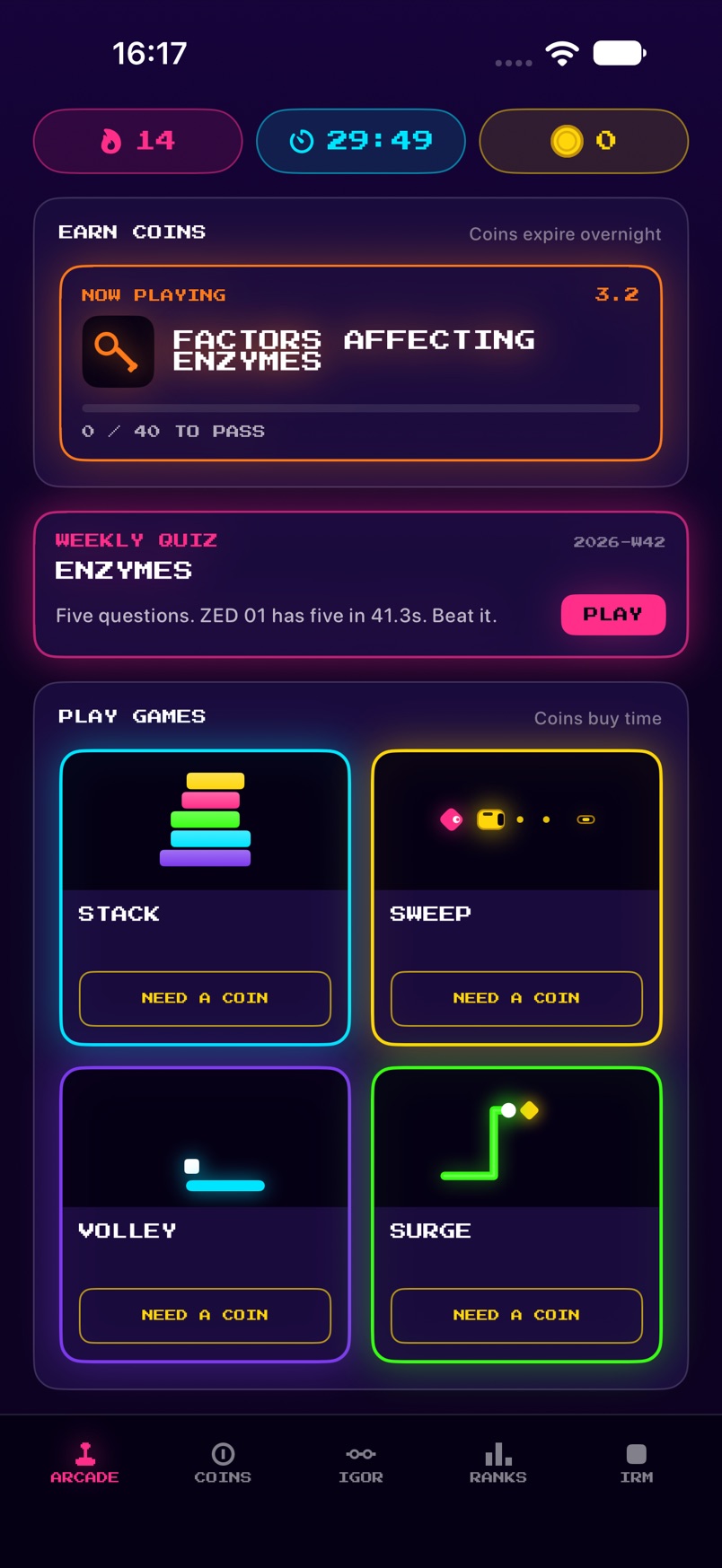
Answer questions to earn coins. Coins buy time on the games. You get thirty minutes a day, then the arcade closes. That's the deal.
Nothing in the arcade is free. Every game is paid for with answers, and that is why it works on a student who would rather be playing.
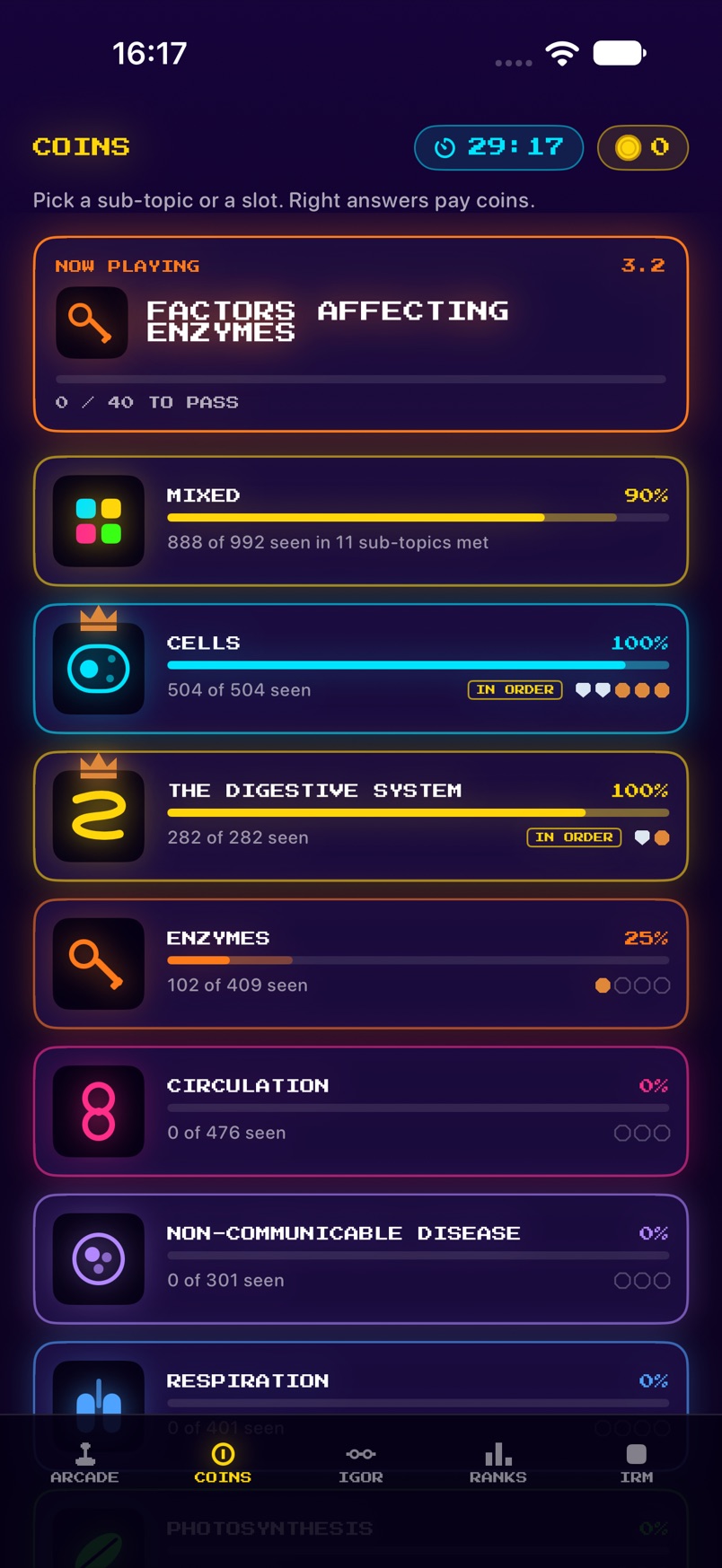
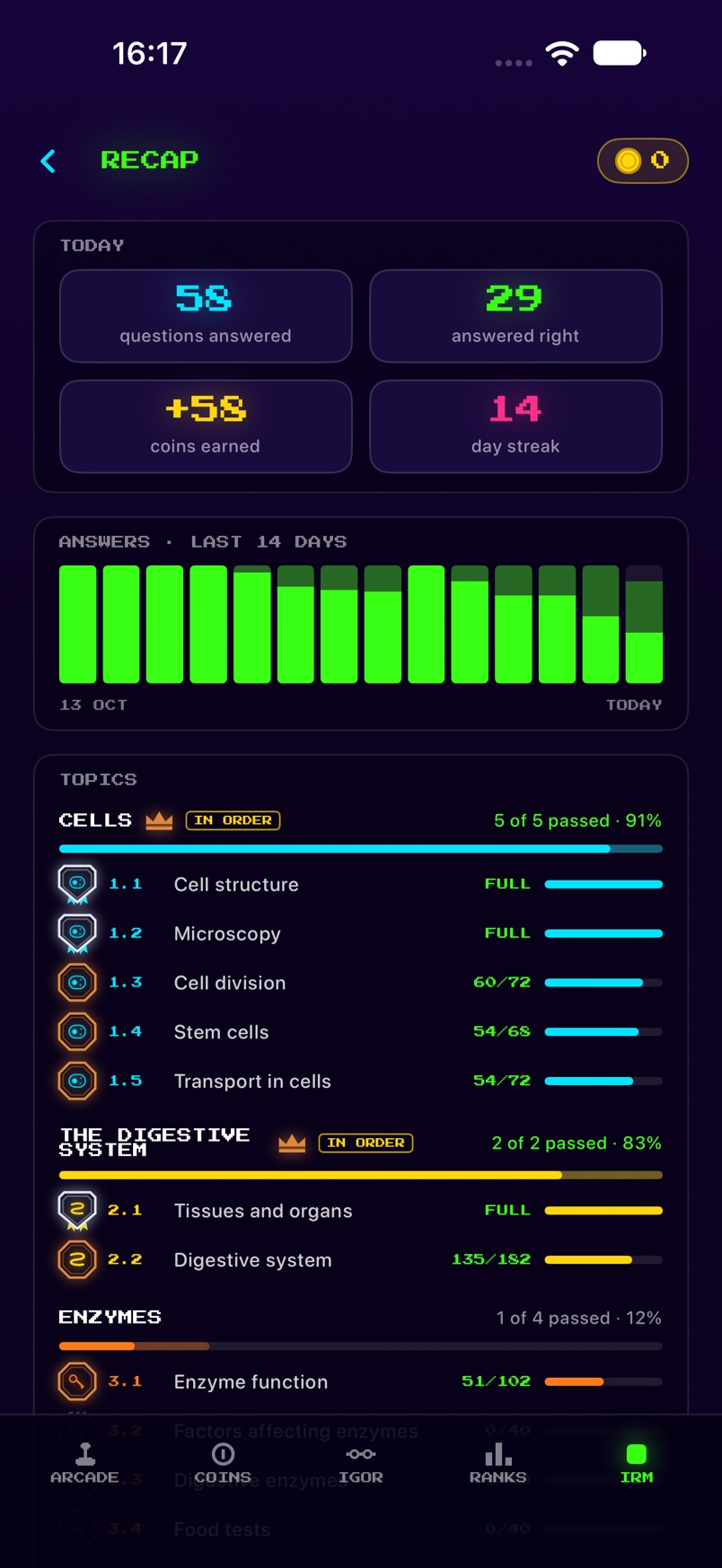
Answer Biology questions on the Coins page. Every right answer pays a coin. Get one wrong and the right answer lights up; the day's report goes over it with Igor's advice.
A coin buys thirty seconds at any game. Go for the high score. When the coins run out, the game pauses until you earn more.
Then the arcade closes and a report of the day takes its place. Coins expire at the close, so there is no hoarding for a weekend binge.
The games are not the product. Revision a student comes back to is the product, and the arcade is what brings them back. Most revision apps bolt a reward onto the work. Lock In wires the reward to the work, so the ratio of questions to games is a number we tune, not a function of how good someone is at Volley.
Answer questions on your current sub-topic. Every right answer pays a coin.
One coin buys thirty seconds at any game.
No countdown on screen. The coin counter pulses each time a coin is used.
The game pauses exactly where it is, even mid-rally. Earn more coins and carry on from the same spot.
Each cabinet is its own arcade original, drawn in neon signage and tuned for one-thumb play. Most fifteen-year-olds have never stood at a real cabinet, and the games are simple on purpose: a coin, a run, a score. High scores go on the boards under your initials.

Tap anywhere to drop the sliding block. Whatever hangs over the edge falls away, and a perfect drop grows the tower back.

Swipe to steer. One touch from a drone ends the run, until a corner breaker sends them running.

Slide to move your paddle. Catch the ball on the edge to send it wide. Three past you ends the run.

Swipe to steer. Every spark grows your line. Hit the frame or your own line and it's over.
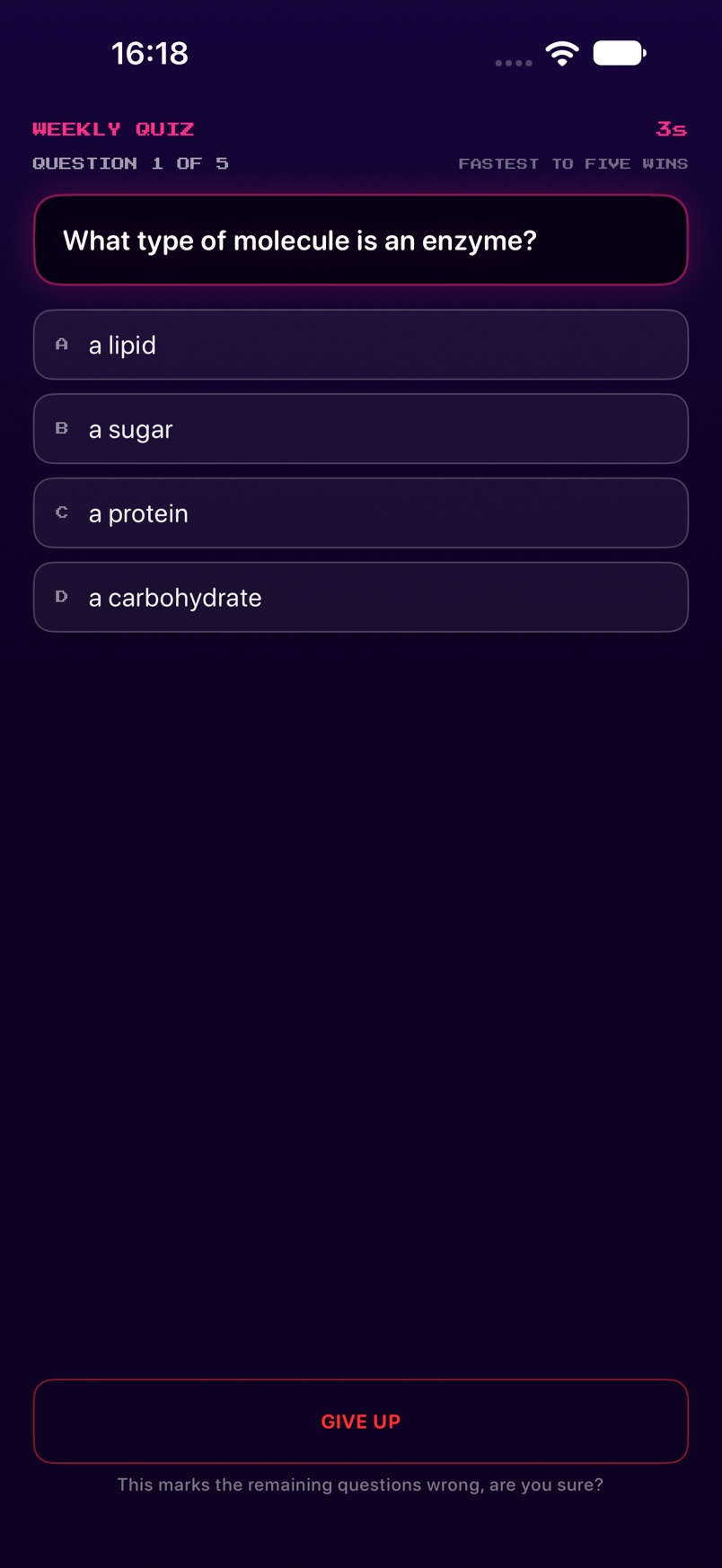
Fourteen packs written to the AQA specification and checked question by question. It is retrieval practice, the kind the evidence backs: a question you have to answer beats a page you get to re-read. Questions come as multiple choice, true or false, gap fill, odd one out, sequencing, labelled diagrams and riddles, so a fact has to be known rather than recognised. Every sub-topic is open, and the current one is always the first thing on screen, so a reluctant student never has to decide what to do next. Going in taught order earns a mark of its own.
Pixel type for the signage, a plain face for anything that has to be read. A question looks the same wherever it is asked.
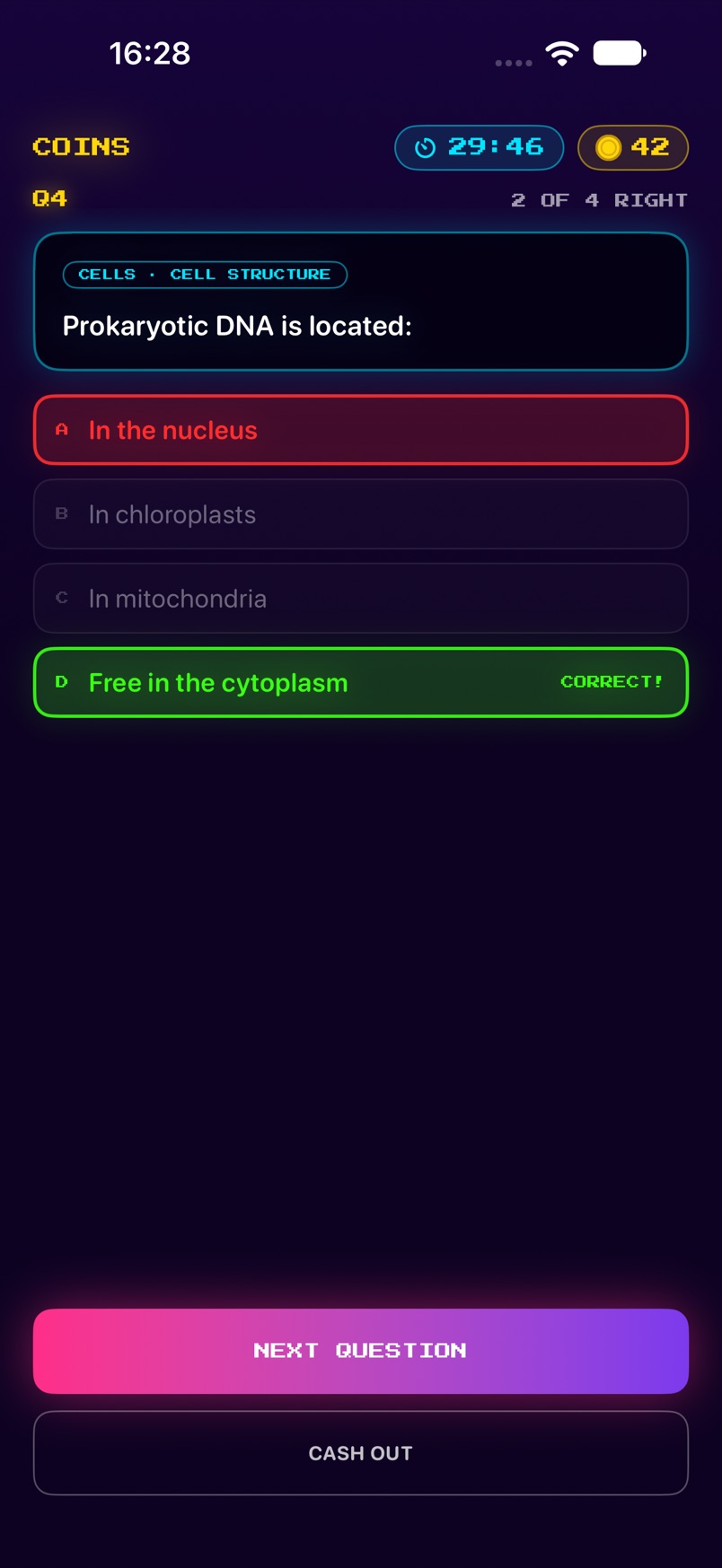
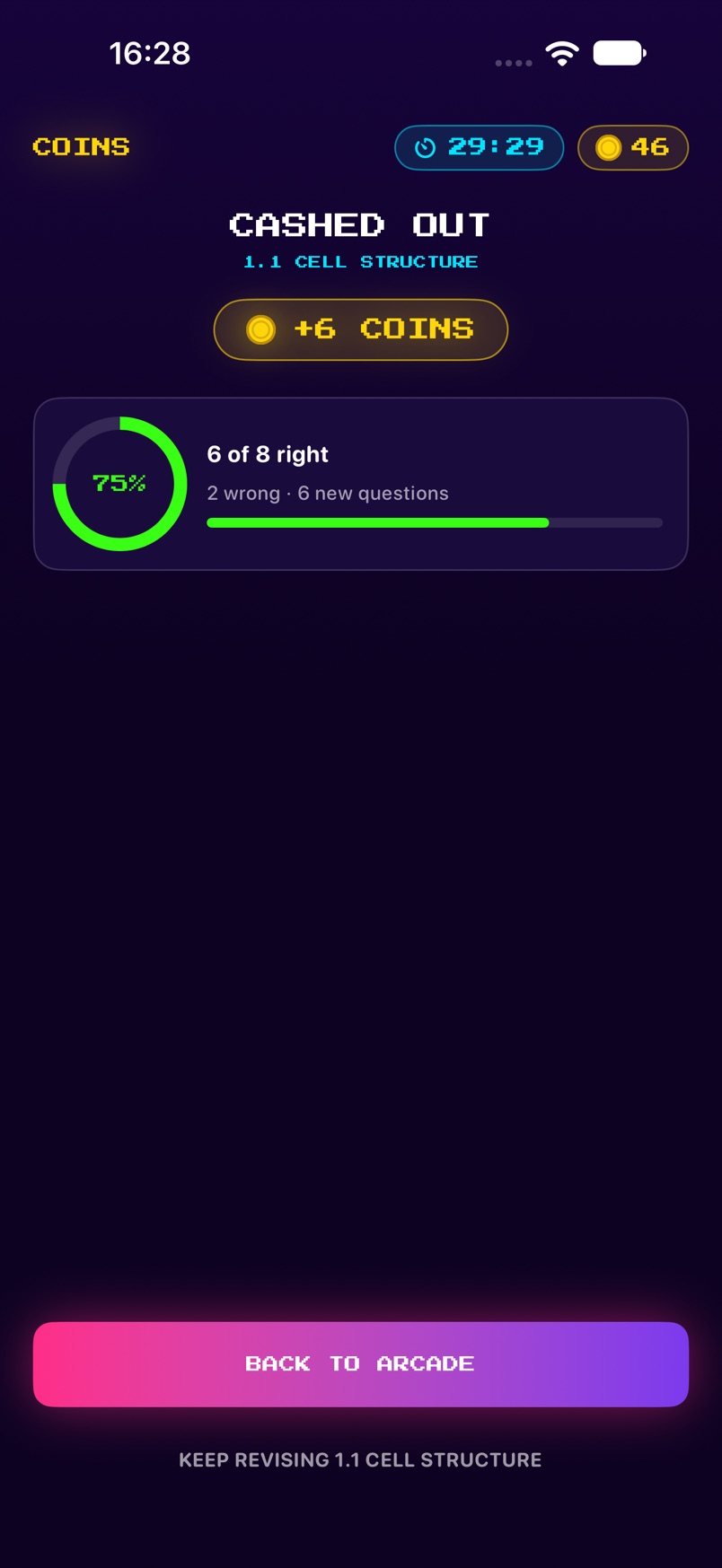
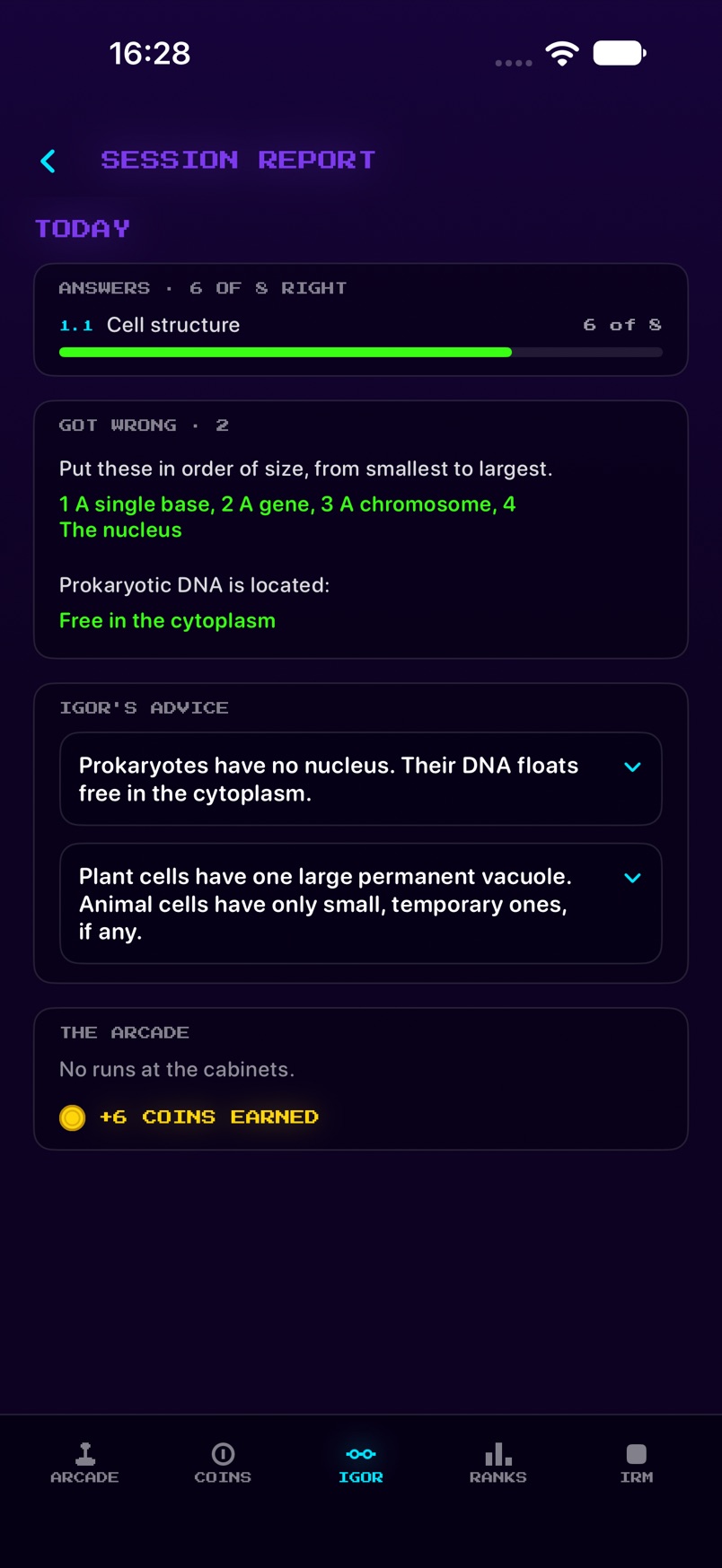
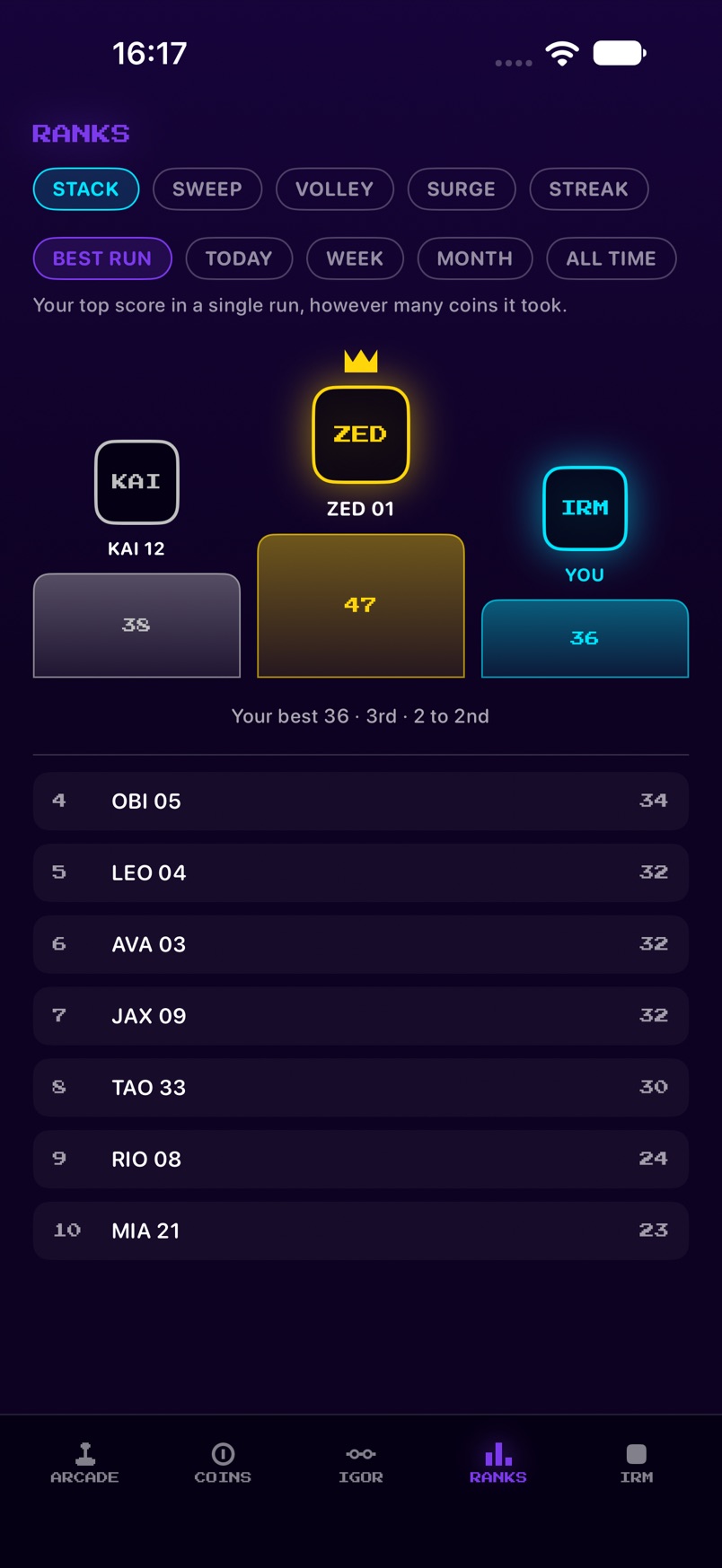
Scores are checked on our side, not on the phone, so nobody can fake their way onto a board. Each cabinet ranks the top ten five ways, and your own place shows under the podium even when it is 40th.
Your top score in a single run, however many coins it took.
Every run added up over the window. A steady player who comes back each day climbs the week and the month even without the single best run.
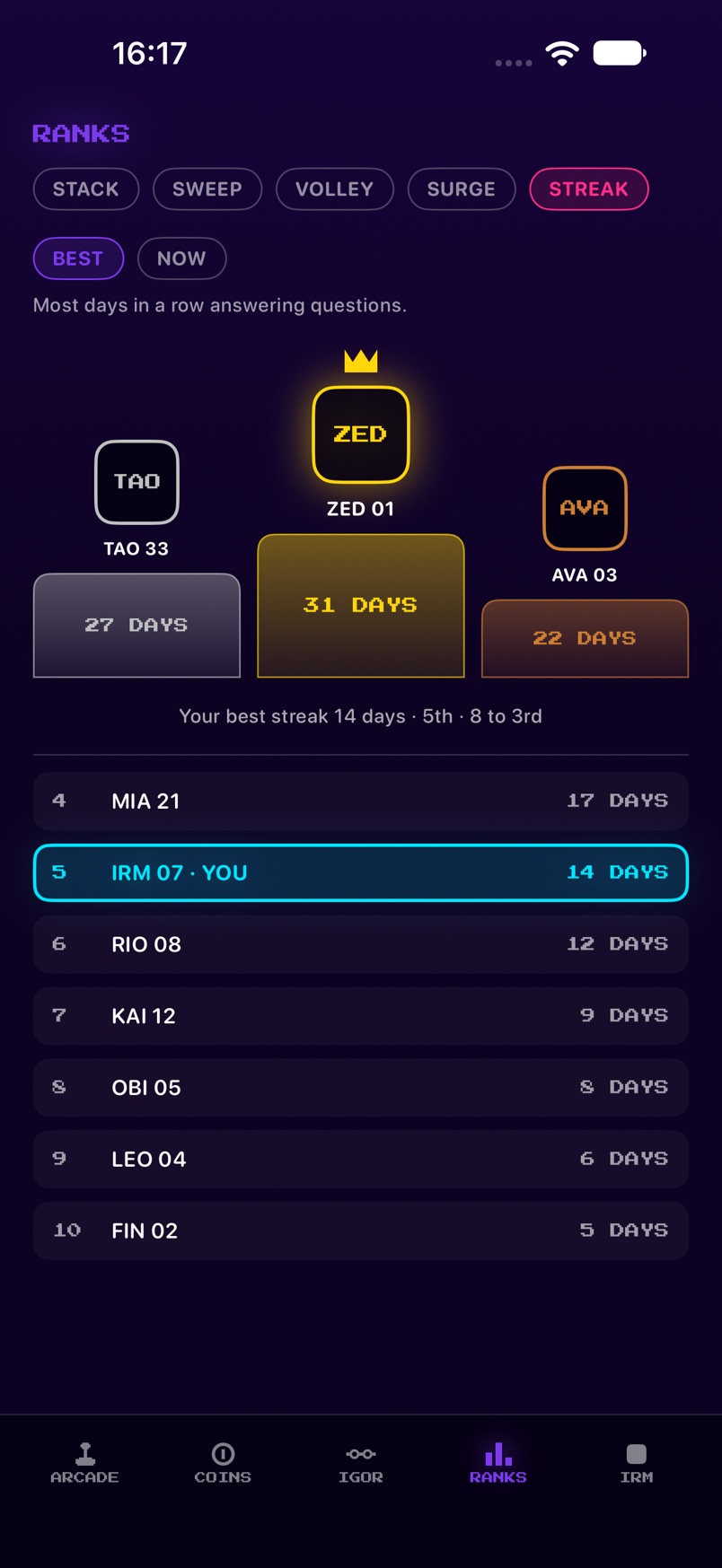
Outside the cabinets, one board for the habit itself: a day counts once a question is answered, and a streak stands until a whole day passes without one. Best streak ever, and the one held right now.
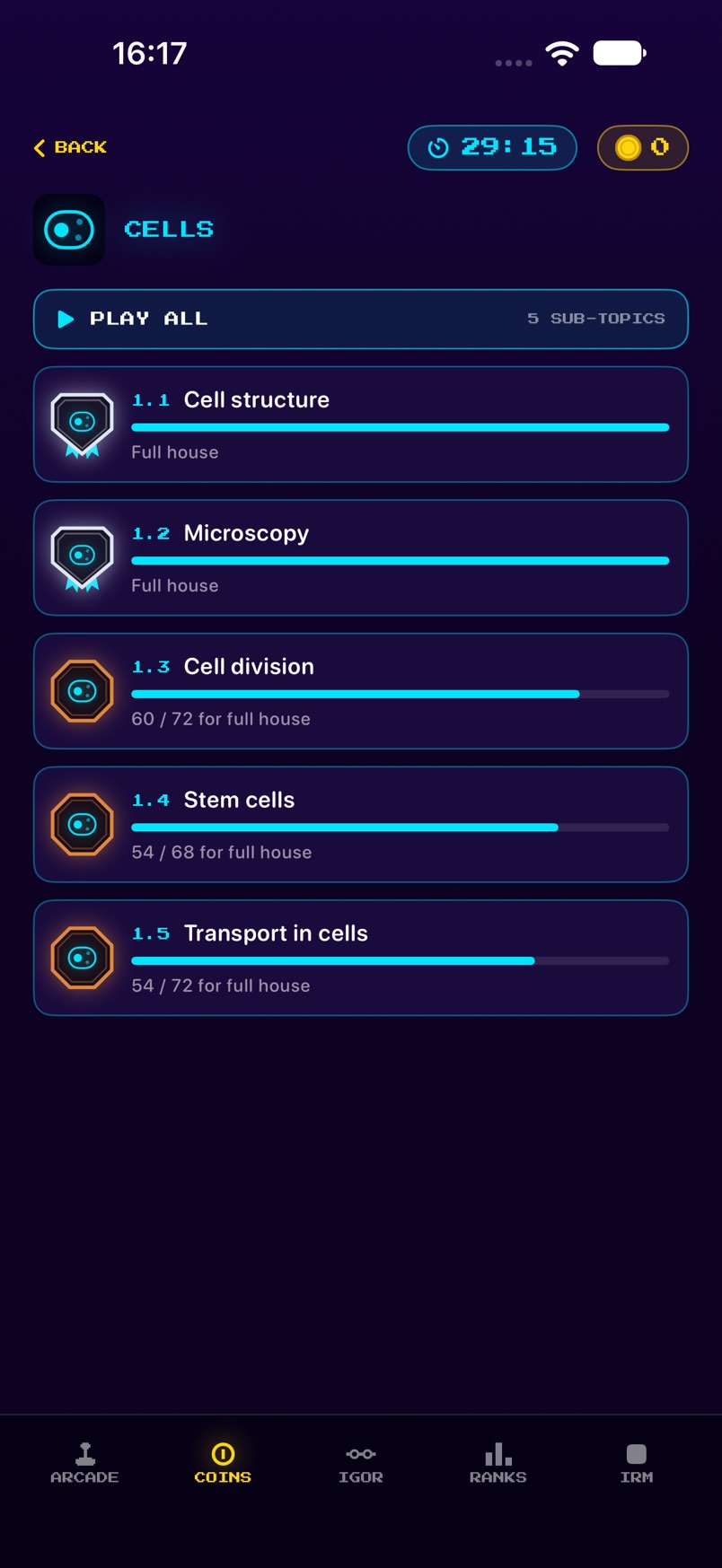
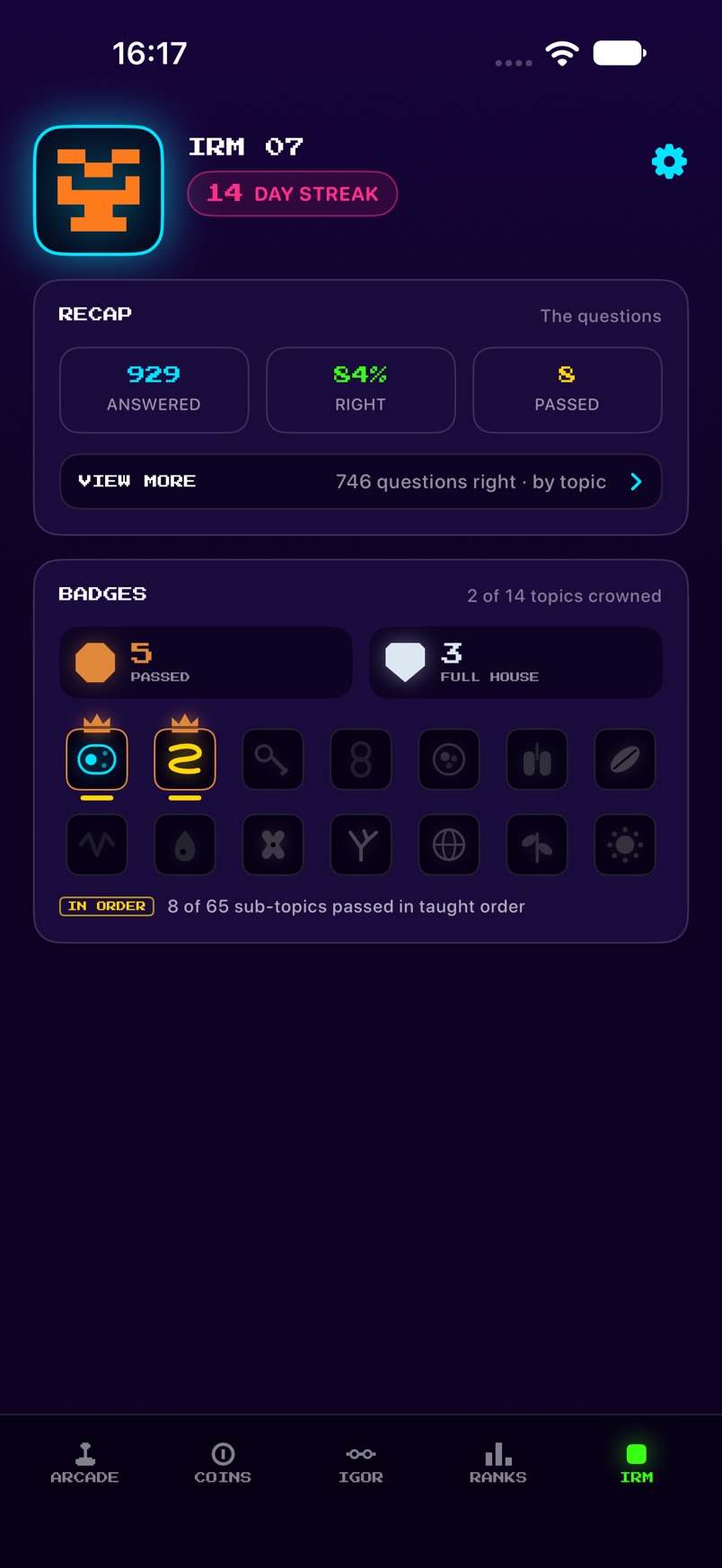
Progress shows as percentages while it is moving. Badges mark the moments it is done, and they never come off: a lapse can drop the percentage, but a badge earned is a badge kept.
Forty questions in the sub-topic answered right on your latest try. About one session's work.
Every question in the sub-topic standing at once. Not a lucky run: each one answered right, and none of them lapsed since.
Once every sub-topic in a topic holds a badge, the topic wears a crown in the colour of the lowest badge among them. Bronze until each is a full house, then silver.
Ex-lab. Long story, involves alarms. He says one line at a time, only when something is worth saying, and he teaches: two pieces of advice a day on the slips you made, and a library of every one he has given.
He remembers what he has already taught you, so he does not repeat himself straight away. He is sarcastic, his compliments are backhanded, and he is on your side.
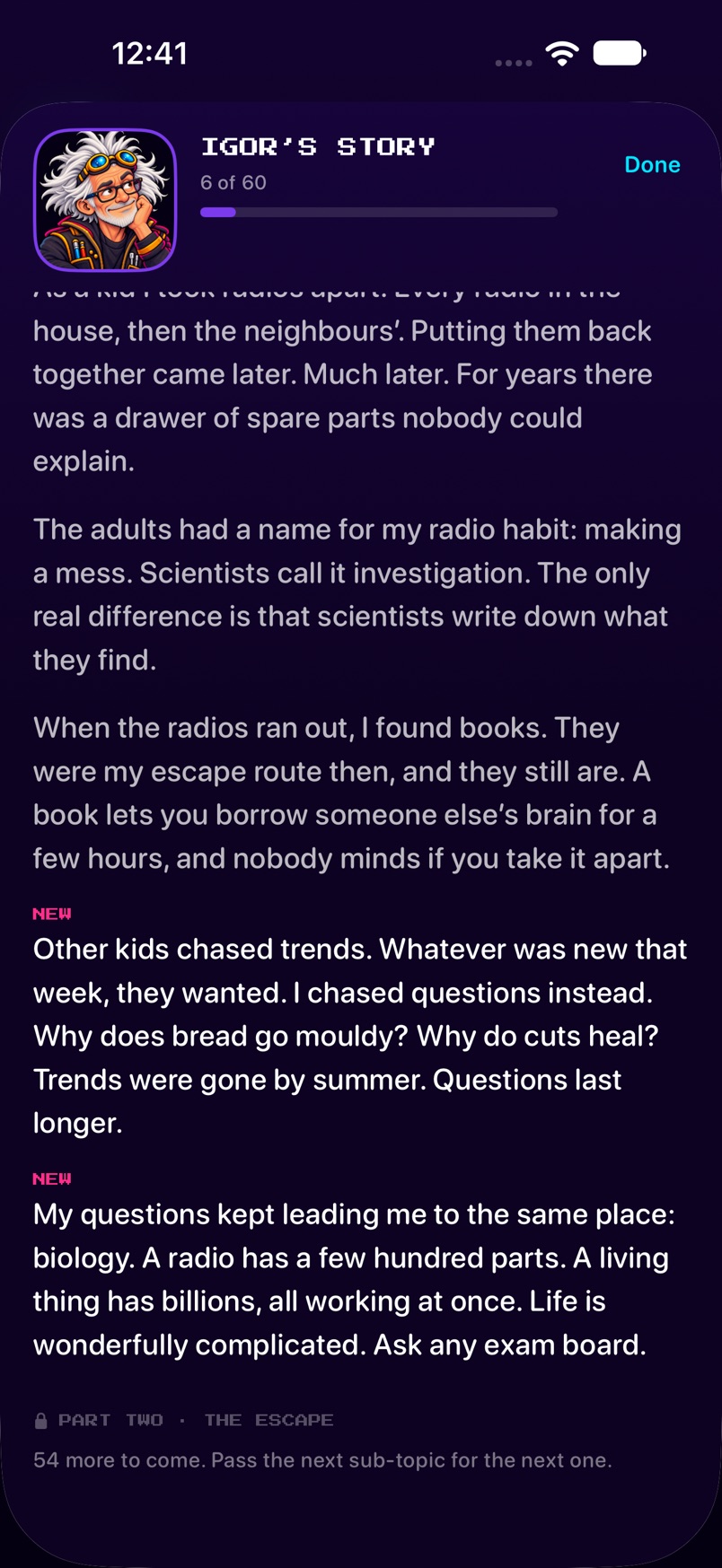
Pass a sub-topic and he tells you a piece of his own story. Sixty of them, in three parts, from the lab to the arcade.

Answer questions, earn coins, spend them on the cabinets. That's the deal.
Biology is honest. People aren't. That's why I teach cells instead of committees.
The cabinets run on coins. The coins run on questions. Blame the wiring. Or blame me.
The limits are in the app, not in a settings screen you have to find.
The arcade is the motive. The work is a large bank of curriculum-aligned questions, asked in enough shapes that a student cannot get by on recognition, and what went wrong gone over at the end of the day.
Biology first. The engine and the arcade do not care which subject the questions are about, so Chemistry and Physics are the natural next packs. If you would like it in a classroom, or want to see the question bank, get in touch.
Lock In is made by Iain and Andrew. One builds the machines, the other spent seven years teaching the subject they ask about.
Iain has built software for a living for years, including an app with the Scottish Government to help farmers in Kenya. Here he writes the code: the four cabinets, the coin clock, the revision engine underneath and the backend the boards live on. If something glows, pulses or pauses on the spot, that was him.
Andrew is a former neuroscientist who left the lab to teach Biology, and taught it for seven years. He met a few people like Igor along the way. He owns the content and the way the app teaches: the question packs, the misconceptions and memory aids, the loop of earning and spending, and the shape of the day. He reads every question before it ships.
AQA GCSE Biology, including the required practicals. Much of the content overlaps with the other English boards and with Combined Science, but the sub-topic order and the scope of each pack follow AQA.
Yes. Every sub-topic is open from the first day, so they can go straight to the one their class is on. Passing a topic's sub-topics in taught order earns it an IN ORDER mark, for those who start at the beginning.
Yes. Every question pack is inside the app. A connection is only needed to sign in and to post scores to the boards, and the app carries on without one.
One thing. The app is free to install, and the first five days of play are free with everything open and no card asked for. After that a subscription keeps the arcade open, paid monthly or yearly, and the yearly plan costs less than twelve months. In the UK it is £4.99 a month or £49.99 a year, shown in the app before you buy. It is billed by Apple and cancelled in iOS Settings. Progress, badges and the Weekly Quiz stay open without it. Coins are never for sale, and there are no ads.
Thirty seconds of play at any game. Coins are used one at a time as you play. Run out and the game pauses until you answer more. Unspent coins expire overnight.
Yes. Every answer is recorded: standing by sub-topic, the questions that keep going wrong and the misconceptions behind them, a streak of days, and high scores at each game under three initials. A passed sub-topic earns a bronze badge, one with every question standing earns silver, and a topic with a badge on every sub-topic wears a crown. The day ends with a report of all of it.
Biology first, and all of it. The engine, the arcade and the shape of a day do not depend on the subject, so Chemistry and Physics are the natural next packs. No date yet.
iPhone, on iOS 18 or later. It is an App Store app; there is no Android or web version.
Free to install, with five days of play free and no card asked for. iPhone, iOS 18 or later. If you teach or tutor GCSE Biology and want to talk about it, get in touch.